Showing posts with label stories. Show all posts

Saturday, March 21, 2020

Pause. Breathe. Rest. Fight.

Well, there is apparently one thing that can stop a dream in its tracks: COVID-19.

After months of planning and getting ready for our big community data story for the spring Arts Walk...it's canceled. And while I am in 100% supportive of the decision to cancel the event, I also know that it is okay to express personal disappointment. I am grateful that I'm (currently) healthy...as are all my friends and extended family...but I admit that I'm quite sad about having to postpone things.

I know it isn't forever. When this pandemic is over, there will be other Arts Walk. We will finish the project, even if it doesn't go on display for awhile.

So, let me tell you just how far we got and what we've been learning along the way. If you need to catch up on the background of this project, you can read an overview or my first reflection on the process.


During the month of February, my assistant and I built relationships with all of the six Boys and Girls Clubs in our county. We visited each one in person to talk about the project and get input from directors about the needs they were seeing with students. By the end of the month, we had returned to four of the clubs to conduct focus groups with K - 12 students. Our conversations were framed around the role of neighbours and friends in their lives. For older students, we also devoted part of the conversation to the community at large.

Some interesting things came out of these conversations. For example, in every group a single (and unexpected) statement was made: We had to move because our neighbours were too loud. We heard this from urban students who live in apartments and rural kids who live in trailers that are out in the woods. We heard it from homeless kids and ones from homes with a stable income. And while we didn't lean into that statement, we did wonder what it was code for. Did it mean their parents couldn't make the rent and didn't want kids to worry...so they just blamed the move on the neighbours? Did it refer to domestic violence or drugs or other environmental factors? Or was it really just plain noise? Another thing that was consistently said across groups had to do with dogs. Kids everywhere talked about being barked at, bitten by, and generally displeased with dogs. Maybe you have a very good boy at home...but a lot of kids are having to manage community spaces where they are feeling threatened by these animals.While neither of these pieces made it into our final survey, they will be reflected in our final display.

Also during that time frame, we worked with a carpenter to build the six frames (one example is above) and 12 boards (one is in the background of the picture above). We partnered with a local upholstery shop to test out different threads and put in our order for our final choice. We secured the rest of the materials we thought we'd need.

By the first week in March we transitioned to the individual surveys. Here are five questions we identified:
  1. I am in grades Kindergarten, 1, 2, 3, 4, or 5.
  2. If I see someone new at school, I introduce myself.
  3. It is important to me to know my neighbors.
  4. I try to build relationships with my neighbors.
  5. I do things in my community that make a difference.
Because the beads are on a ring, we needed a way to consistently tell which question was the first one. But this wasn't quite enough, because even if you could identify question number one, you couldn't tell which was question two. So, we ended up creating two questions with binary answers and using two sets of colours (white, grey for Q1 and beige, brown for Q2) to start things off. Questions 3, 4, and 5 use a three-response option (often, sometimes, rarely).


We were able to get one afternoon of surveying in before schools were closed. If things were different...if this pandemic was something that would have swept through in a month and been gone...then we did have a plan to capture more data. Our Boys and Girls Clubs are open to provide childcare for first responders and other emergency service workers (in addition to their regular clientele...in groups of no more than 50) and we could have asked them to do paper surveys and then string the beads later.

We also identified the questions from our statewide Healthy Youth Survey to pull from district-level data. Here are the questions we intend to showcase for each of the six districts, as a way to compliment the data from the six clubs in their respective areas:
  1. There are adults in my neighborhood or community I could talk to about something important.
  2. My neighbors notice when I am doing a good job and let me know.
  3. There are people in my neighborhood who encourage me to do my best.
  4. There are people in my neighborhood or community who are proud of me when I do something well. 

We did not write the five questions for the community survey during Arts Walk (the interactive part with the string). We do intend to have one question that is the same for both the K - 12 survey and the adult survey. I suspect it will be question 3 or 4.

I won't pretend that the answers for six months from now won't be vastly different. At least, I suspect they will be after we get through this crisis. I think we will look at neighbours and our roles and responsibilities to the community very differently. I kinda wish we'd been able to finish this display before the outbreak...and then do something to look at these same questions through the lens of "after." 

For now, everything is frozen in time. The display...the launch of my bigger dream (The Data Lab)...and more. I am not the only one to find themselves in this situation. For all of us, we're in a type of stasis while other things get sorted out. I am trying to remind myself that this time to pause and reflect and rest will provide the resources to fight hard later.

And I will.

Thursday, February 13, 2020

We're Going to Need a Bigger Dream

There is an exchange between the two main characters in the 1954 version of A Star Is Born that often sticks out in my mind. James Mason's "Norman Maine" has just discovered Judy Garland's "Vicki Lester." And as they get to know each other, the dialogue goes like this:

Vicki Lester: [Norman has finished looking through her scrapbook] You know as much about me as I do myself. But... you see how long it's taken me to get this far. Now, all I need is just a little luck.

Norman Maine: What kind of luck?

Vicki Lester: Oh, the kind of luck that every girl singer with a band dreams of - one night a big talent scout from a big record company might come in and he'll let me make a record.

Norman Maine: Yes, and then?

Vicki Lester: Well, the record will become number one on the Hit Parade, it'll be played on the jukeboxes all over the country... and I'll be made

[laughs self-deprecatingly at the implausibility]

Vicki Lester: End of dream.

Norman Maine: There's only one thing wrong with that.

Vicki Lester: I know - it won't happen!

Norman Maine: No, it might happen pretty easily - but the dream isn't big enough. 
 
Someone once reminded me that we don't all have James Mason character's in our lives...someone who suggests that you shouldn't settle for the little dream...that you should move on to the bigger one. And this has been sitting with me as I've started down this road of the community-based data story that I described in the previous post. With every conversation, the dream gets bigger. This is mostly because it isn't just my dream anymore. Each person breathes a little more life into it and it is slowly inflating like a beautiful balloon. It also feels so much lighter and easier to carry as it grows. And while this seemed counter-intuitive to me at first, I have realized that with more and more hands to lift it, maybe it does make sense that my part isn't as heavy. I have also noticed that when I start to feel tired or overwhelmed by this whole thing that someone else steps up to offer to schedule the next meeting or make the next phone call. It is not dependent solely upon my focus and energy. Others are going to ensure that it happens.

I have never had this experience before, and I have to say that it feels pretty magical. It still feels a bit terrifying at times...like, can we really do this? And I also have brief periods of disbelief...like, is this really happening? But I am treating this like an adventure, or at least a journey of sorts. I am meeting all sorts of characters along the way. I am learning, sometimes the hard way, about questions I should ask and things I should have prepared for. Yet, we are moving forward with this grand design. A very chatty carpenter is building a display. A local car dealership donated all the keyrings we needed. The owner of an upholstery shop has helped us find the right thread, after reminiscing about the designs he used to make. 

This is at once the most challenging, yet most fulfilling, thing I've ever done. There is power and energy here to make a difference and a lot of conversations about the future. It is exhausting, but oh so satisfying. Onward we go.


Monday, February 3, 2020

Creating Connections

I usually write about the data stories I build when they are complete. But this one is a little different and so I am starting its documentation at the beginning.

Inception
A few months ago, I was unhappy at work. The change in leadership has not been a positive one. I still love my job (and those people I have worked with over the years), which creates an interesting challenge. Some friends suggested that I just wait out the bad seed, as those never grow for very long. But I am 50 years old now. I have spent nearly all of my working life waiting for some dude to move on. I'm tired of that...and it doesn't do anything to create a better system for younger women, people of colour, or others from underrepresented groups.

So I pondered my options:
  1. Wait it out, as suggested. Hope new leadership is competent and supportive
  2. Look for a similar job to what I have now, since I like the work
  3. Do something different
But, why choose when you can have them all? Just going with Option 1 is untenable; however, I can't just up and quit, either. So, I'll just keep my head down and work and have as little interaction as possible with the leadership at hand. I'm not particularly interested in Option 2, as it would mean uprooting my entire life. There is a similar job to my current one that is posted in a district north of Seattle...and pays $50K more a year than I make now. On one hand, it seems silly not to apply for it. And, on the other, chasing money for its own sake is also silly. Option 3 is even riskier. Not that I haven't taken leaps before or that I feel too old to do so now. But I had to spend time really thinking about what that would be. If I could have any job I wanted, what would make me happiest? I realized that what I like the very best about my current job is working with people to use data to answer their own questions and tell their own stories.

Are there jobs like this...at least in how I envision them? Kinda. There are things like We All Count, and DataKind, and The Data Lodge. They all have some pieces I like. I've described a bit of what I want in a previous post. As I thought more about putting something like this together, I realized that I would need to build up some demand for it. I would probably need to keep my day job (sigh) and do consulting work on the side until I reached a tipping point of time and money to make the jump to "dream job" full time. And as much as I want it now, I also recognize that I just need 5 years to maximize my retirement options with the state. If I build capacity in the next few years, I can leave education knowing that when I reach retirement age, I will have all the benefits waiting for me.

How would I create the demand, I wondered? And then I thought about an idea that's been in the back of my mind for a year or two. People who have my role in other school districts often tell me that they wish they could build these stories, too...or at least that we could do one together. Why not start now? Better yet, what if we connected the work with a community-based organization (CBO) that was working on a strategic plan or needed some large-scale input? I remembered that I knew someone who was leading just such an organization. We had coffee one morning and the idea was off and running. I chatted with people in my role in neighbour districts...and the idea grew longer legs.

The final piece was to find a space for a display of the data story. Our town has an Arts Walk at the end of April, which seemed like a good opportunity. But what about the right place to host? I made a short list of spots in the middle of the event that I thought would have enough floor space for the design we had in mind. I reached out to the first one—our city's performing arts center—not expecting them to say "Yes." But they did, teaching me a very valuable lesson about being careful what you wish for...'cause you just might get it. They expect foot traffic of about 2000 people. 👀

Last week, I measured the space...met with one of the school districts involved (as well as the branch of the CBO we're working with in that area)...and tried not to be terrified of the enormity of what I've started. I am beyond excited about all of this, but it has been so long since anything positive has happened in my working life that I'm not sure how to mentally process this turn of events.

The Story
In my conversation with the leader of the CBO, he identified three major areas the advisory group of his organization had identified as issues students across the county are facing:
  1. Needs for support with mental health
  2. Lack of connection to others and community
  3. Lack of a sense of purpose or direction
It's important to note that the advisory group consists of people from the county courts, school districts, and business community—all of whom work with K - 12 students, but from different angles. They all see these issues as critical to address. My connection at the CBO said that he thought the second one was most important because working on that could lead to some gains in the other two areas.

Connection is a very powerful concept. Not only was there a ready-made analogy with all of the players for this data story, but it's something that everyone (regardless of background or age) can comment on.

The Plan
Yeah, yeah, I know. For my first time out, you think I could have picked a smaller bite to take. But that isn't how I roll. It's a good thing that I am a planner and I have a lot of support.

We'll spend the next month doing some focus groups and identifying 3 - 5 questions for an individual student survey. In March, we'll have 2,000 - 3,000 students respond to the survey by building a ring with pony beads, like the one shown at the right.
The colours of the beads will represent a scale, as yet to be identified. The rings are zinc wire keyrings. Each one is about 1" in size. We think we can make these items for about $200.

We're supplying frames with wire in them—much like a window screen, but much larger gauge. When a kid completes their survey, they will be able to attach it to the frame. There are six clubs/districts, so we'll have six sets of these. We'll connect these with some additional information supplied by districts to form a much larger structure.

And then, in April, we'll work on building the community response piece. Our plan is to do something like this:

https://datastori.es/data-stories-58-domestic-data-streamers/2-data-strings-pcp/

The actual questions and categories will also be driven out from the focus groups. But the Arts Walk participants will add the strings as they pass through the space.

After the event, we plan to repurpose the student pieces into smaller, tabletop versions that are specific to a school district and can be displayed in other places for other conversations.

And then we'll see.  I'll keep you updated as this project continues to move forward. I have done this enough now to know that I need to stay flexible and that things never go 100% according to plan. There will be all sorts of things I haven't anticipated. Either this will be the starting point to a different world for me, or I will fail spectacularly. I am very much committed, regardless of the outcome. I will be footing the bill for this project out of my own pocket. I have skin in the game. Keep those good thoughts headed this direction.

Sunday, February 2, 2020

Data Stories: The Next Chapter

When I started my data stories project in 2016, my goal was to build 10 stories in 10 months. Silly me. I had no idea of how ambitious a goal that was...or the twists and turns my journey would take along the way. Here I am in my fourth year of building these, and I have finally completed number 10. But I think about possible ideas for more all the time, so maybe I should update my goals and vision for this work.

Will I stop building these for my school district? Probably not. I do see 10 as a milestone, mainly because it was the original intent of the project. But I love doing them and their impact on others has surpassed anything I'd imagined. I will tell you that women and people of colour engage with them far more than the white males in my organization. That is not an indictment of that group or how they best engage with data. I've just come to realize that I'm not making these stories for them...and that's okay. They have plenty of other data representations that they like. But for everyone else, there is a sense of wonder and recognition in their eyes...an awakening of sorts. I am making it sound more dramatic than it really is. It's just hard to describe how people who aren't pale males look at these stories and talk about them...as if until that moment, they hadn't realized that this was the thing they were missing and someone finally showed it to them. Anyhoo, now that I've wallowed around in trying to learn how to build these things, I want to make sure I empower and equip others to do this, too.

Here are some ideas I'm thinking about pursuing in future stories...
  • I want to find a student or two in each school to give me a tour. I don't want the compliant, good-grade, class president type kid to do this. I want the one who is always asking for a hall pass. I want to see a school through the eyes of a first grader—what is the purpose of various rooms? what's the best part of the playground? I think these maps would be very interesting.
  • In a similar vein, I'd like to shadow students at different grade levels and track all of the things they touch during a school day. I wonder if I could build a physical tree map of these data—a shadow box with paper, wood, metal, and other materials in the proportion that students use them.
  • Thanks to data walking and participatory walks from Elastic City, I am thinking about what this could look like for our district. What sort of community data walk could I put together?
  • I continue to be intrigued by the concept of a "good school." I think there might be ways to capture data in the wild about this—the conversations that happen in the grocery store or at soccer games...the ones where parents and the community talk about us and come to their own conclusions. 
There are bigger things on the horizon, although they are still shrouded in fog. I would love a job where I work with groups to help them develop meaningful goals and ways to use related data (and have started on creating The Data Lab). I am interested in building more personal data stories to share (or sell). What would a novel look like? The life of a historical figure? My notebook is overflowing while my time allowance is not. Transitioning away from a steady paycheck and benefits toward the unknown is also not realistic at this time, but I continue to look for opportunities. I'm open to figuring it out. Dreams need time and space to breathe themselves into existence. In putting them out there, I am committed to seeing them develop.

For now, I am grateful for all I've learned over the last few shares...and the opportunity to share it with others. I am looking forward to the next chapter of the story and whatever is found on that page. I am already enmeshed in another data story project involving six school districts, our county-wide Boys and Girls Club, and city Arts Walk. I'll document some things along the way as we move data stories out further in the great wide world.

Thursday, January 30, 2020

Ten: The Turning Point

In the fall of 2016, I set out to tell 10 data stories in 10 months. It was an ambitious, but naȉve goal. Oh, I suppose I could have done it as long as I told tiny tales (short stories?). That's not what happened. With each story I built, things got both larger and more detailed. The materials I used were a better quality. I learned to dance with The Muse, understanding that it could be weeks or months in between the visits that would generate ideas and propel me forward. I shared with others and it has all become so much larger than some little side project. It's become a way of thinking and discipline and a path forward into what I want to do next with my life.

So, here we are in the winter of January 2020. And 3.5 years after I started this whole thing, we have finally reached the 10th story...but certainly not the end.

This is a story about how well our district serves students who have only attended our schools.

The Data
There was a lot of data with this one...the most I have ever tried to represent. And while 18,500 data points might not be overly large if you're working with them in a digital format...trying to show them physically is a time-sucking nightmare. In the end, I think I found an efficient way.

I pulled longitudinal (grades K - 12) data for current seniors who have only ever attended a school in our district. There were 175 of them (out of ~600). I wrestled with which data sources to use for quite awhile. Part of the challenge is that 13 years is a lot of opportunity for data systems and data collection to change. In the end, I was able to gather attendance, discipline, health room visits, enrollment in special education or the free/reduced lunch program, and performance on state assessments.

Now, out of the 18,500 possible data points, "only" 10,000 or so had something that might require representation. For example, not every student received special services (and those who did were not necessarily served every year), we didn't start using our information system to collect health room visits until these students were in third grade, and state testing doesn't happen at every grade level.

But 10,000 is still a lot. And while two of these areas (special education, free/reduced lunch) were binary, the other four had quite a range. I had to decide what sorts of ranges might be important. For a couple of these (attendance, performance), there were some already established parameters (e.g., "chronically absent" = missing 10% of the days in a year). For discipline and health, I developed some reasonable, but arbitrary, ranges. Although this might be a little indefensible, it also has the benefit of protecting student privacy.


The Build
I went round and round with this one for a long time. I really wanted to build something like a game board and with the various stops (grade levels) to the end (graduation) I wanted to share some additional information about that year and the changes to both school system and the world at large. I still think this is a great idea for a future story, but I just couldn't make it fit this one.

Somewhere along the way, someone shared a link to work by Caren Garfen. Some of her data representations use buttons or dollhouse plates or other tiny objects. I think these are so very interesting. And while I didn't end up moving in that particular direction, it did inspire me to do some sort of series of objects. This is where I finally (!) had my big a-ha. What was a small object that had six sides for my six data sets? Sure, you're probably thinking of dice now...but I thought of a pencil. What a perfect object to use. Pencils are long enough to hold longitudinal data, but small enough that 175 of them will still fit in a reasonable space.

I marked the pencils in 1 cm increments, starting at the eraser, to represent each grade level. I put one to six dots on each side of the pencil (toward the end that could be sharpened) to designate which data set was represented on that side. Then, I used leftover paint from the On the Bubble story to encode the data. This was incredibly tedious and not as precise as I would have liked, but I made it work. I sharpened the pencils that represented students who were on track to graduate at the end of the year.

After the pencils were ready, I covered six 24" x 36" cork boards with material. Five of these were designated to hold the pencils and the other for annotations. I used painters tape at measured intervals
to mark the places where cup hooks would be to hold the pencils. I used a drill to create 350 tiny holes in the boards and screwed in the hooks. All that was left was placing the pencils, adding the annotations, and hanging the boards.

This is the most interactive visualization I have ever built. Each pencil can be independently turned so that viewers can investigate and see whatever story they want. I tried to be strategic about the sides of the pencils and which data sets were there. Attendance and performance are next to one another. Health room visits and participation in the free/reduced lunch program and neighbours. A viewer can look at the same side of every pencil at once, or pick a section (e.g., at-risk students) and look for commonalities. There's also a certain gestalt associated with seeing each elementary and how many students started there and are still with us. Even taking mobility out of the equation, there are very definitely some catchment areas where the overall instability is having some sort of impact on the ones who stay.

I thought a lot about labels for this story. For obvious (i.e., legal) reasons, I did not want to add anything to the pencils that would indicate gender, race, etc. I considered some summary data—for example, numbers or percent of females/males. But in the end, I decided to let the students label themselves. I emailed all of them and asked them for their five-word stories. Not all of them wanted to contribute, which was fine, but I liked the idea of pairing how they define themselves vs. how the system sees them. It's been awesome to read what they have to share.


Lessons Learned
This story took months. I first pulled data in early October...and it was just over three months before the final product was complete. My biggest lesson along the way had to do with  figuring out what happens when you have too much data. Just use a sample? Find a different story? Aggregate things? I won't claim I found the best solution, but it has been a very valuable thought experiment.

I also just had to trust the process with this one. There were several times when I wasn't 100% convinced I was on the right track. But I ended up with something incredibly personal, detailed, and very cool. The addition of student input has also been valuable. Kids have said how honored they feel to be represented, but I hope that in the long run, they will think about the imprints they leave behind and how those do or do not represent them accurately. Doing these data stories has certainly left an impression on me over these last few years...and in the next post, I'll share more about how I plan to use them to leave an even bigger impression in our community.

If you'd like to see more pictures or learn more about our data stories project in our school district, please visit the companion page on our district web site.

Monday, January 13, 2020

Coming Soon: The Data Lab


I know it's been quiet here...but I'm still around, thinking and working on various things. My latest data story will be complete this week. It's taken a few months to represent nearly 10,000 data points, but it is looking good. More on that soon.

But today, I want to commit publicly to what's next.

It's been a challenging year at work. I still enjoy my job a lot, but not necessarily the conditions I have to currently work under. Enough said. So, as I've been talking with others about this and pondering what I want to do, I have found myself thinking about what I want. What would my job look like? And in the midst of all that, I developed what I started calling "Crazy Idea #1" and "Crazy Idea #2."

Crazy Idea #1: Community-based Data Story
I've pushed out our district data stories into the community for the last couple of years, but what if I helped the community push out one of its own? What if I worked with an organization that needed community input on their strategic plan or other goals? What if we linked with other districts to leverage our data and resources?

And, crazy or not, this idea is in motion. I've identified an organization that is working to help students in our area build their capacity to connect with their neighbourhoods and community. I've talked with my counterparts in other districts about some data that we have in common to share. And soon, I'll be working with a few thousand students to create a data story that we will share at our city's spring arts walk. It's terrifying and inspiring...the perfect intersection of emotions to get me excited about going to work (regardless of whoever and whatever else is there).

But most importantly, I plan to use Crazy Idea #1 to launch something even crazier.

Crazy Idea #2: The Data Lab
You see, what I really want to do is support people in using data to answer their own questions and tell their own stories. And while not all of those stories need to take a physical shape, I can honestly say that getting your hands involved builds understanding. So, to that end, I want to develop a physical space for people to come and work with data.

I see this as a storefront in our downtown area. The front would have some retail options—journals, art supplies, all manner of sticky notes, and anything else you might need for capturing and representing ideas with data. But the biggest part of the store would be a conference space...something with flexible furniture, idea paint on the walls, carts with materials, a large screen, and anything else needed for learning. I see this as a place to host workshops on all sorts of topics, data walks, group work/planning, and more. It will be a lab for building stories. I want it to have a 3D printer and laser engraver and band saw.

And my audience? Being in the state capital, there are plenty of options—from lobbyists to state agencies to schools to community-based organizations. Most importantly, I want it to be a place where all are welcome and that underrepresented groups can have their voices lifted. I want to support and grow others.

But to get there, I have to build my reputation outside of school districts and demand among other organizations. I need some time to build capital (social and monetary) through consulting so I can have enough momentum to launch the physical space. Crazy Idea #1 is going to be one of those steps.

In the meantime, I have commissioned the logo you see above. (It's not finalized yet...we're still making a few edits.) I am teaching a class on data use at a local university this spring, and that will give me an opportunity to test out some hands-on workshop ideas. I've purchased a couple of domains. And I'm off to meet with the local center for women in business to try and get smart about that side of things.

When I talk about this idea with people who know me and know my work, they all see the potential. And while I know that they're biased (as am I), I've also never been so clear on what I want in my life...not even when I picked teaching for a career. I realize that there will be lots of twists and turns on the path ahead...plenty of setbacks and disappointments...and that the final product will be different from the vision I have now. But I accept that as part of the bargain.


What do you think? Any feedback on the logo or ideas? Are there people I should talk to who do similar work? What else would you advise?

Wednesday, August 7, 2019

Nine: Chart a Course

I'm so excited to share this project with you. It's been a long time since I felt like there was some magic in the air...and when The Muse came back, she did so with a vengeance.

This is a story about whether students who have similar paths (in the form of schools, teachers, and courses) experience similar outcomes (in the form of performance).

The Data
There are a lot of data packed into the representation of each student: gender, race, with/without disability, eligible/not eligible for free/reduced lunch, performance level for grades 3 - 7 on the state math assessment, teacher for grades 3 - 7. I built a template to pull these pieces from our student information system, but beyond that, I did not need to transform any of the data—no formulas, pivot tables, etc.

I did generate an alias for every student and teacher, because I fed their connections (which student had which teacher/course) into the Connect the Dots tool on databasic.io. I will explain the reason for this later on in this post.

The Build
The entire display is paper and glue, with map pins to attach each "student" to a board. That's it. The representations were built by quilling paper. I love that these data look fragile, but I have to tell you that the pieces are strong and resilient...much like our students. Also like our students, nearly all of them are unique.

Here's what you're looking at for a student. The star is made of 5 rays, representing the five grade levels (3 - 7). Grade 3 is in the 12 o'clock position, and the rest follow as you move clockwise around the star. If a student didn't attend one of our schools for a given grade level, there is no ray at that position.


The paper colour for each ray shows what the performance level was on the state math assessment for that grade. Orange is level one (well below standard), yellow is level two (below standard), light blue is level three (at standard), and dark blue is level four (above standard). Each ray is wrapped in a piece of coloured paper to indicate a particular teacher/school. We have six elementary schools serving grades 3 - 5, so there are six sets of colours: orange, purple, green, blue, red, and yellow. There are two middle schools serving grades 6 - 7, represented by blue and red. If a student attended one of our schools at a given grade level, but didn't take the test, the ray has the outer wrapper and is empty for the performance level.

On the inside of each star are four round disks of paper in white (w) and grey (g).


Note that we did not have any non-binary students at this grade level last year, so male and female were the only categories. I also collapsed our students of colour into one category, and while I strongly believe that this is not best practice, I am also legally obligated to protect personally identifiable information about students. At this grade level, we have some racial populations with only two or three students. When faced with a choice of leaving race out of the conversation completely or summarizing it into two categories...I chose Option B. Certainly, there are other data points I could have selected here, such as attendance or discipline. But I like that the center of the star includes some "internal" attributes that students bring with them, while the outer rays represent the "external" pieces in the form of teachers and system outcomes.

Here is a small group of students that shows the variations by missing grade levels, missing scores, gender, etc:


Now that I had 452(!) of these objects, I needed to figure out the connections between them. This is where the Connect the Dots tool helped. For each school, I uploaded a coded list of students and teachers. The online tool produced a network diagram like the one below, but more importantly, it provided me with a table showing me who was in each group, as well as the connections.

I selected the stars in each group and laid them out as a constellation. I placed stars that had teachers/courses in common closer together. Most of our elementary schools had 6 or 7 constellations. Here is one of them (before labels).


Each elementary school was organized on its own 24" x 36" cork board that had been covered in fabric. Stars were attached with map pins and then annotations were added to share what the group had in common. The six schools were organized into two sets of three, because we have two feeder patterns into middle school. This allows a look across the district.


Lessons Learned
When people use the phrase "labour of love," I will now know what they mean. I personally wove every piece of paper used in this display. I spent about 300 hours total building this story out of 3200 pieces of paper and a bottle of glue. Most of the work was done during my summer vacation: early mornings, late nights, weekends, at home and while visiting others. I drank a ton of coffee (mostly decaf, I promise). I got glue all over everything—my computer, my dining table, me. I have never devoted so much time and energy to creating one of these stories. But it was all worth it. This is the most beautiful display I've ever built. But beyond that, it is fascinating to look at. There is so much meaning packed into this. It captures and holds one's attention.

One of the things I have to remind myself is that when I uploaded the information about students and teachers, that was it—no information about gender, race, etc. And yet, it is obvious with some of groups that they have some of these attributes in common. In other words, the system either does or does not support certain types of kids. Now, this is not new learning, especially at a large scale level. But we are talking about small groups here. Let me give you one example. For students who take the advanced math track on one side of our district, one school only placed males there...the second nearly all males...but the third placed about even numbers by gender. What was most interesting about this third school is that nearly every girl who was in this track and successful in math had the same third grade teacher. That one teacher was the common denominator...and that group was different from every other in the district. And until I built this display, I would never have seen this. I was also surprised at how different every student appeared. Yes, I know that every child is an individual, but this display really drives it home. While there are a few (but not many!) students who had the same five teachers, they did not have the same internal attributes or the same outcomes.

If you'd like to see more pictures or learn more about our data stories project in our school district, please visit the companion page on our district web site.

Tuesday, August 6, 2019

Eight: Unmasking LAP

I have had this post in my queue for a few months. Last school year was a hard year, for a variety of reasons...and I didn't feel like publishing to create any reminders of it. But I have something super-special (finally!) to share tomorrow, so I'm pushing this one out the door today.


I finally built and shared my first data story for the 2018 - 2019 school year. While I originally had some big plans for data stories this year — including community involvement — this has not turned out to be anything like a normal school year. I'll spare you the gory details, but just say that the impact of all the turmoil has been that I mostly don't feel interested in creating anything...even though my passion for this project remains. So, over the last three months, I have been chipping away at doing something and hoping that this will rekindle some joy.


Background
I have been wanting to look at our intervention data. In our state, supplemental funding is provided via the Learning Assistance Program (LAP). The goal is to work with students who are at least one grade level behind in reading or math and accelerate their learning so they can meet grade level expectations. Our district uses nearly all this funding in our elementary schools to buy teacher and paraeducator time. These interventionist use a "pull out" model where students come to a separate space each day for up to 30 minutes of extra instruction, tutoring, and support. Each school determines which grade levels to serve, which area (reading or math), how to group students, and what materials to use. There are a lot of variables, but the bottom line is really about outcomes.

What I've noticed over the last several years is that once a student is identified for LAP services, they rarely make enough progress to exit the program. The primary reason why they leave the program is that it's the end of the school year and there's no more time. However, the news isn't all bad, but it's still challenging to identify what it means for the program to be effective.

The Data
For this story, I pulled student performance data from fall and winter for every K - 5 student who has been served in LAP this year. I wanted to look at both growth and proficiency across schools. I also wanted to show some of the difference in the populations we serve — for example, a student with low-performance might receive support at one school, but not another, just because of program capacity and the volume of students to serve.

After I pulled assessment data for each of these students, I found the raw difference between the number of points earned between fall and winter. I compared that with the amount of growth necessary to maintain an "at grade level" performance between those two time points and identified each of the LAP students as having less than or at least that amount of growth.

The Build
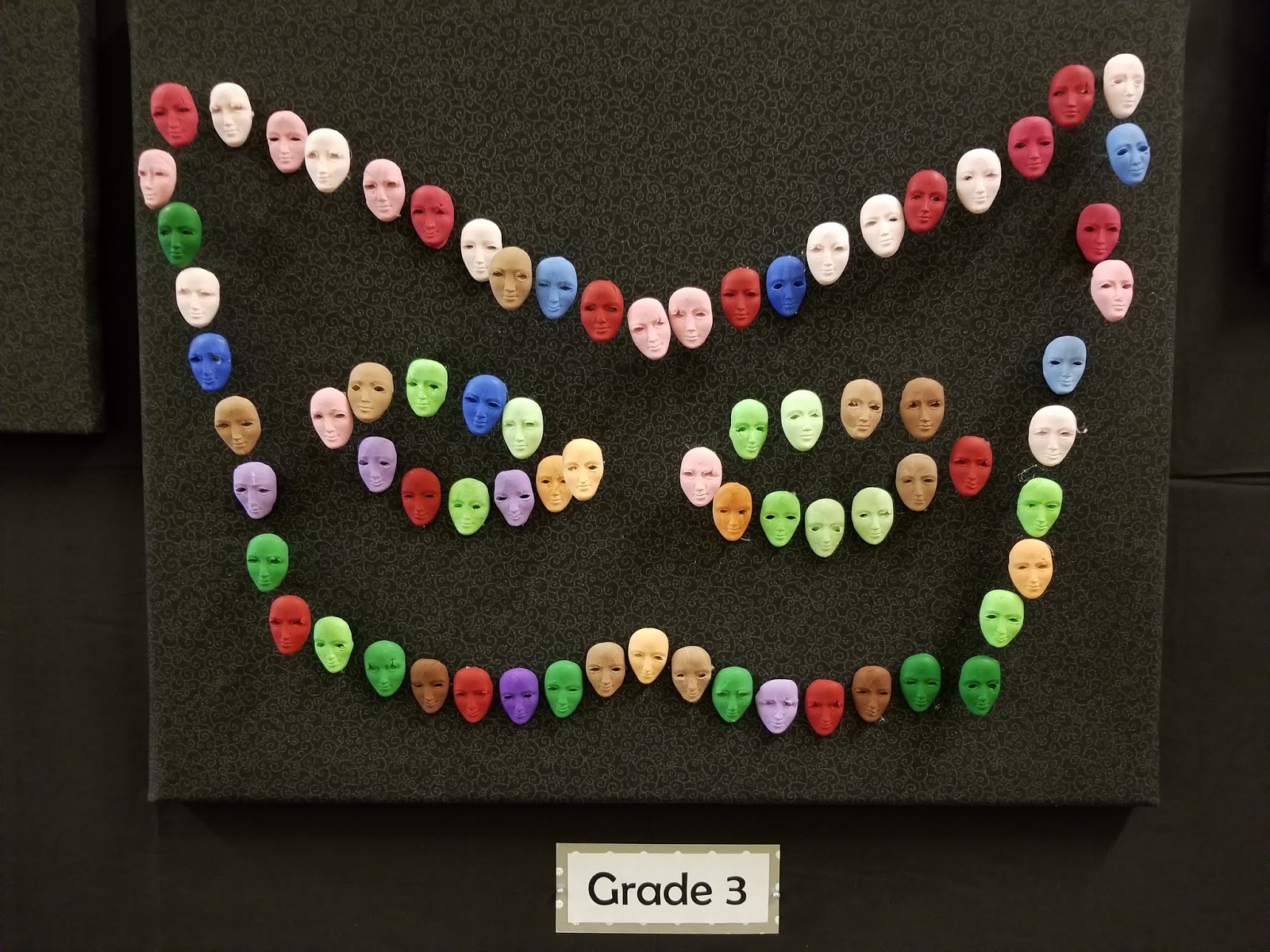
I used Sculpey clay and a mold to create a face for each student. We have six elementary schools, so six colours (orange, blue, purple, red, green, brown) were used. The clay was tinted to create a gradation of each colour to represent the number of years the student had spent in the intervention program. More years equaled a darker hue. Faces representing students who had made more than the required amount of grade level growth were attached to a pin so they would stick out from the board, creating a 3D effect.

 I used six boards, one for each grade level. Students were placed on the board based on how much overall growth they had made between fall and winter. This was not an exact placement—I used a bit of artistic license to group students. My goal was to create a mask shape with the faces, with the idea that we were trying to reveal something about the program.


Lessons Learned
I have to admit that this was not my favourite project to do. It was important from the standpoint that I needed to get back into producing stories again and this forced me to at least think about communicating with data. However, it did reveal some things about our intervention program, including that it's not particularly effective. Considering the state gives us nearly 2 million dollars to run it, I'm not convinced it's a good investment of taxpayer dollars. This is not to say that students don't grow or that for some individuals it provides good support. It doesn't mean that there aren't some adults in our buildings busting their rears to make a difference for students. But if the goal is to get every child to be able to perform at grade level for reading...well, there's not a lot of good news in this story. When I think about the students who have spent multiple years in the program, I wonder why we keep exposing them to the same intervention and expecting a different outcome. What should we be doing instead? We still haven't had that conversation in our district and honestly, I don't know if anyone is interested in doing that.

Saturday, July 7, 2018

Road Map

I consider myself an organized person, but not much of a planner. At least, I don't do a lot of long term planning. I have never had a career path that I've mapped out. I didn't decide I wanted to be a teacher until the month I graduated from college...and since then, I've more or less fallen into different jobs when recognized Opportunity knocking at the door. I am also a fan of her sister,  Serendipity. In fact, this is one of the reasons why my current home is my favourite place I've ever lived. There are little bits of magic and wonder to be found every day. I don't offer or condone any of this as the best approach to life. I am always in awe of those who have clear goals and seem to be driven toward them. It just hasn't been my experience...and I am okay with this.

So, imagine my surprise when, by chance, I found myself writing a theory of action, developing a logic model, and outlining a plan for some long-term goals with a data initiative. Who the hell am I becoming in my old age? But if you've been following my journey here over the last year or so, maybe some of what I share below will not be a surprise. In fact, I'm hoping that some of you might like to play along, too.

Theory of action
Here is my current, messy thinking: 
If we increase data literacy in ourselves and others, then participation in conversations at school and with the community will become more equitable, and then structural and institutional barriers to education will be reduced.
I've spent a lot of time in the last couple of years trying to ground myself in what I believe about data and the purpose it serves in education. I might summarize this as that I don't think that we can solve problems by representing our data in the same ways and having the same conversations as we have before. Whether your call it an achievement gap, opportunity gap, or educational debt, the bottom line is that we've been well aware of disproportionate outcomes for a long time...and yet another bar chart showing this isn't going to be the thing that creates change. I won't claim that I have THE answer or any sort of magic bullet, but I do have something different. I think that's the best place to start.

The plan
I've been working on some ideas related to community engagement with data, building data literacy in parent groups, and empowering underrepresented voices to tell their stories. And the more I read and think and develop these ideas, the more I recognize that there are some goals and outcomes that are bigger than I'd ever imagined. Serendipity has been an incredible guide and inspiration to this point, but I can't make the next leap (or two) with her alone. I'm going to have to have some real help.

Stage one: Build capacity in self
Not to be intentionally selfish, but this part of the process really is all about me. Perhaps you have projects where you are in the same mode. This has been a long-gestating stage. I went to my first Tapestry and Eyeo conferences more than two years ago. I've been building and sharing data stories in our district office for nearly that long. On the way, I've had to pick up new tools and skills and increase my personal network to call on experts and mentors. I don't believe that this stage will ever end—I will always be a learner. But I also think it's important to call it out separately as a base for everything else I want to support.

Stage two: Build capacity in organization
This past year, I've worked on not just sharing what I've learned at presentations and blog posts, but also leading workshops and building GitHub sites with resources. I've now seen others build their own data stories to share and grounded school leaders in our district in basic data literacy.

Stage three: Build partnerships outside of the organization
I am working on finding spaces outside of our district to host our data stories. Currently, Ready or Not is at our regional educational office and our story on graduation is at the state department of education. And last week, in a frisson of why-the-hell-not, I cold-called the data analytics business downtown and asked if they would host a window display during our city's fall Arts Walk. You see, I've recently been building "short stories"—smaller versions of the big displays—to take on the road. And while I won't claim that they are art, they are beautiful and good conversation starters. Why shouldn't I share them at a community event?

Another piece of stage three is a pilot project for next year where we will use some of the data therapy activities and other resources to increase data literacy in a parent or community group. But most importantly, this is not a project solely about pushing out some learning that we think is critical. It is about an opportunity to listen to the questions others have about our schools, as well as help them tell their own stories about what matters most to them about education. I am super-excited about this, even if I have no clue right now how to make this all happen.

Stage four: Empower the community
On one hand, this is really just an extension of stage three. If we do a pilot this year, then we will scale up afterward. But this is also where things get so big that it can't be "my" project anymore. This is a good thing. It means that I've been able to build enough capacity and partnerships that I can take a supporting role. What will all this look like? It might be a lot like the work showcased over at Making Sense. They have a whole toolkit ready and waiting. I also 💕 love 💕 this article on Data in Place: Thinking through Relations between Data and Community. I don't know what the outputs of this project will look like for us because we haven't implemented all of stage three yet. We will have to wait and see what our stakeholders think is the most critical issue to address.


So, there you have it. My plans for world data domination. Okay, maybe not as grand as all that, but I am hoping for a ripple that one day can become a wave. And this is where you come in, too, because everyone is welcome to join in. Are there activities you want to try, too, so we can learn from each other? Do you have connections or resources to share? What feedback or ideas do you have for us?

Friday, April 20, 2018

Seven: Care to Comment?


What do we say about our students? Do our values align with the words we use? Do they reflect what parents think is important about what happens in the classroom?

In this data story, we take a closer look at 3,694 comments written about 2,862 K - 5 students on their winter report cards.

The Data
Similar to last time, there wasn't anything especially fancy in terms of getting the data. We have reports in our student information system that will gather the information and spit it out into a spreadsheet. After that, I added student demographics and program information from another student file using trusty old INDEX/MATCH.

The big challenge part was getting the data clean...or, at least, cleanish. You see, I didn't want student names. Why not? In part because I wanted to make some of the data available to others. This means I needed to strip out identifying information from the text. Also, the names interfered with some of the frequency counting and comparisons I wanted to make. (Aside: Do you realize how many kids are go by the name "Maddie"? I didn't.)

I did a first pass using the SUBSTITUTE function in Excel. I had Excel replace any occurrences of a student's first name with "" to blank it out. However, this only worked when a teacher used the actual name of the student. Many kids go by nicknames, shortened versions of their names, first and middle names, etc. I'm sure there must be better ways than looking through things row by row, but that's what I ended up doing.

The Analysis
After the spreadsheets were all cleaned up and ready for church, I looked at some different options for doing the text analysis. I don't have any real experience with this, and while I looked as some fancy options like Overview, KH Coder, and Emosaic, I just didn't have the time to devote to digging into them right now. Instead, I used the WordCounter and SameDiff options over at DataBasic.io.

The WordCounter provided the basis for the word cloud you see in the picture at the top of this page. I used SameDiff to compare lists of comments for male and female students, for example.


There are also comparisons for students who receive special services (vs. those who don't), students eligible for free/reduced lunch (vs. those who aren't), and students of colour (vs. white).

I also used a couple of pivot tables in Excel to summarize and sort through the data—for example, the total number of comments per grade level or per student population.

The Build
Compared to the last few data stories we've built out in the hallway, this one is less complicated. There's a lot of paper and stickers, with some foam to help provide dimension to the word cloud.


I knew I wanted the background to be yellow...something bright for spring, but neutral enough that the black lettering could pop. We put the word cloud in the center of the board. It has the 50 most commonly used words. On the outside, we have the four pairs of lists with words that are only found in comments for students in a particular group. The list for our students who receive special services is particularly depressing.

But wait, there's more...


This is our first data story which uses two boards. On the second board, we have information for our students in secondary grades (6 - 12). There are two middle schools and two high schools. Teachers have a list of "canned" comments at each school that they can assign—two per class per grading period—as opposed to the freeform comments elementary teachers create. For these students, we did some simple counts of how many comments per student and then underneath those charts are lists of the most common and least common comments selected. On the right of the board, we have an area for people to leave comments for us.

This second board isn't as sexy as the one for elementary, but I'm still excited that we have represented something for every school and every K - 12 student (even if they received no comments).

Lessons Learned
This is one project where I would have loved to have rejected the null hypothesis: the idea that there isn't any difference between student groups. But even with this very basic analysis, I couldn't. Even though most of the text is pretty much the same across student groups at the elementary level, the bottom line is there are some differences in how we talk about boys and girls...and for students of colour...and students from low-income backgrounds...and those who receive special services.

We may never eliminate bias, but if we don't bring it to light, we can't start to address it. While it's great that our district is taking on several initiatives around inclusion and cultural competency, but these are useless if we only use them to pat ourselves on the back for starting them. If we can't change the system in meaningful ways for students, we are just as complicit as those who built the structures in the first place. This display is one way to raise some awareness of what we're up against.

To see more pictures of this project, or view frequency tables of the comments, please visit the page for this data story. As always, comments welcome!

Thursday, January 11, 2018

Six: Ready or Not


This (school) year, I have built a story about our high school seniors...and one for our sixth graders...and now I'm moving down to kindergarten. For our sixth data story, we are looking at early learning data. What does it mean to be kindergarten ready?

As usual, I didn't set out to tell this particular tale. I was totally going down a different path, thinking about student absences and creating some sort of strip plot...and as I doodled over dinner on the longest night of the year, The Muse came calling. And in about 10 minutes, I had the whole thing in mind about how to present our early learning data.

Our district has been participating in the state-mandated WaKIDS assessment for three years. Teachers collect observational data about each student's development in six categories: social-emotional, physical, cognitive, language, literacy, and math. There is a 9-level scale for each item, with birth to age 1 being the lowest and third grade being the highest. Only eight of these are shown below, as no child in our district was rated the lowest level in any category.


The Data
This story was one of the easiest in terms of managing the data files. The state provides us with a file of everything submitted by teachers, and then I merged in a few other demographic and program pieces. This time around, there were no statistical shenanigans, just total counts for each category and level.

The Build
Do you remember these? Usually built with pony beads, they have made various appearances throughout the years to signify friendship, solidarity, remembrance, or another purpose. Perhaps you wore them on your shoelaces or the lapel of a jacket.

If you haven't seen these sorts of things, they are constructed from safety pins and beads. I remembered them when I was still pondering the strip plot idea and veered off into how I might be able to string or hang beads from a line. Once I thought of the safety pins, I made an immediate connection to early learning (even if we don't use safety pins for diapers anymore).

After I had the concept, I knew I could build a safety pin with beads for each of our 486 kindergartners. Some back of the envelope calculations showed that I could fit 6 beads (at .5 - .6 mm each) on a 2" safety pin. This would allow me to show all six data points of the assessment, using beads with colours matching the developmental levels indicated by the teacher.


But what else could I encode, I wondered?

In divining the entrails of the data, I noticed that there were a few student attributes that might be worthy of further attention. First was gender. It is not uncommon to hear parents talking about "red shirting" young boys to give them an additional year to mature...but do the data bear this out? I ordered two types of safety pins to help us look at this: gold for girls and silver for boys. The second piece was a student's birthdate. We have a cutoff of September 1. If a student is not 5 years old by then, they can't enroll. But does that really matter---are older students more "ready"? I decided to encode this using different colours of map pins to attach the safety pins to the display. I picked red (because it was not one of the 8 colours of beads) for students who had a birthdate less than six months prior to the first day of school and white pins for older students. Finally, what about low income status? I didn't want to mark this by individual student, due to privacy issues; but, as I organized the pins by school, I decided to order the schools by their overall percentage of students who have low income status. That would give a general comparison. I did look at and consider race; however, I did not represent it with this display because (a) it was actually not as influential a factor as the others for this particular data set and (b) I couldn't represent it as accurately as it deserves. By this, I mean that with student privacy laws, by the time I made a pin showing race and gender, it could become very easy to associate the data with a particular child...especially as most of our schools might only have only one kindergarten student of a particular race. (Yes, we are very white.)

So here, is the final display:


The pins are organized in the space for each school by those kindergartners who were reported as most ready (all purple---or better---in the six categories) to least ready. As you can see in this broad shot, the school with the greatest percentage of low income students (PGS) has a lot lower proportion of all purple pins as compared to BLE, our school with the lowest percentage of low income students.

Here you can see the red vs. white map pins. Do you notice how many white are at the top and how many red are toward the bottom? This seems to tell us that age does matter a bit. Older kids are more ready. And I like seeing this, because while we might be able to talk about potential bias when it comes to gender, teachers don't have birthdays memorized or have an obvious way to connect them while working with students.

It's harder to see in the picture at the left (but you can click to embiggen), but gender also seems to play a role in how students are viewed in terms of readiness. Remember, gold pins represent girls...and by the time we get down to the bottom two rows, there is a lot of silver showing. I do wonder whether bias factors in here. I also noticed when I put the pins together that many of the girls were not rated as highly in math as they were in other areas. Hmmm.

Finally, you might notice the labels beneath each board. These are actually little booklets for each school with charts that show aggregate data. Viewers can look at the distributions for each category or for the demographics of the school. If you would like to see these charts, additional photos, or explore the web-based data workbook, please visit our district web site for this display.

Lessons Learned
One of my colleagues has said that this is his favourite story that I've built. I am very happy with it---we encoded a lot of information into a small space and were able to include every child. The pins jingle and move. The paper sparkles and feels sandy. Light refracts through the beads to make them glitter in the light. I think folding in elements of touch and sound is a critical piece of this work. I know that those aspects don't represent anything in particular about the data, but they invite people to ponder...and that's what I'm after: Engagement.

I also think it's interesting to compare schools and see how they used the scale for this assessment. One school (LRE) only used three levels---all of their pins only have purple, blue, or green beads. Another school (PGS) used eight levels and really differentiated. One school (MTS) is very large (106 kinders), but only 2 were rated as being kindergarten ready in all six areas, while all the other schools had a much larger proportion.

As we get ready to work with our community about registering kindergartners for next year, it will be interesting to think about how this display impacts our conversations. I already had one co-worker spend some time looking at it as she thinks about whether or not to enroll her son with a July birthday in school next year.

I am more than halfway through this project of building large-scale, analog, interactive data displays. My goal is to build ten...and I have four more to dream up and construct. The Muse will be back. I don't know when or what she'll bring, but I will be ready.

Sunday, November 26, 2017

Walls that invite others in: Transform your conversations about data

Last spring, I was invited to put together a 3.5 hour workshop for our state assessment conference that happens every December. I was told that the topic could be anything I wished. And, of course I agreed to do just that and hastily wrote a description in early June...and by the time my summer holiday started in July, I was already panicking. What the hell had I written? How was I going to deliver on this description?

Public narratives about schools often focus on measures of student performance. However, students are more than the sum of their test scores, demographics, and program participation. Join our conversation about how to repurpose and leverage data walls to create, inspire, and communicate with audiences about what matters most. As part of this interactive session, we will share examples of innovative data stories from both school and district levels, as well as tools and strategies for constructing new narratives about student and school outcomes.

Basically, I said I would facilitate some learning around how to build the sort of data (story) walls we've been doing recently. This sounds great on the surface. I truly believe that we have change the types of conversations we are having with and about data in education. In practicality, however, it turns out to be really challenging to develop guidance on how to listen critically for opportunities to transform these interactions...much less how to tap into and be confident about being creative with displays. As Isaac Asimov said, "The world in general disapproves of creativity...and to be creative in public is particularly bad."

I made a lot of notes this summer based around my own questions about using data, and this fall, I've been chipping away at organizing all my notes from the last 18 months into some sort of outline. Combined with the data academy work I'm guiding this fall, I have felt overwhelmed by the amount of adult learning I need to generate...all while trying to do my "regular" work.

https://twitter.com/science_goddess/status/930421496538841088
But, at long last, I think I'm ready for this workshop...which is a good thing, because it will happen on Wednesday. I don't have a lot of time left to fuss with it. It's time to fish or get off the pot, so to speak.

The slide deck is 150 slides (and 90 MB). I have around 10,000 words in my speaker notes. I've incorporated references to King Kong, Frankenstein, Pink Floyd, ETA Hoffman, and The Inferno. And, I've built a companion site on GitHub for all of the other links, references, handouts, and structure.

We'll see how this goes. Three and a half hours is a long time to spend with 40'ish people on one topic. The whole premise---building these oversized, experiential data installations---requires a different sort of investment and risk-taking on their part. I am not foolish enough to believe that they will all go back to their schools and districts and put up these displays. But let's say three of them do. What a wonderful start...and how I would love to know of others who are doing this work. It all has to start somewhere. I will plant seeds now and see what sprouts.